
The Fairfield County Most Wanted Program
Fairfield County posts no countywide most wanted roster. Connecticut gives that job to others. The county has no county government, no sheriff, and no county criminal court, so warrants come from the state courts. Municipal police and state officers serve them across Fairfield County. Public alert pages, where they exist, belong to the Connecticut Judicial Branch, local departments in Bridgeport, Stamford, Norwalk, Danbury, Fairfield, and Greenwich, Connecticut State Police, the Department of Correction, and federal units when federal process is involved. Those city pages offer records contacts and tip channels, but none publishes a general Fairfield County warrant list. For your own status, start with the limited Judicial Branch VOP/FTA search. Then ask the criminal clerk at the issuing Superior Court to confirm the record. Read any alert only on the agency's live page.
No Fairfield County Warrant Roster
A missing roster is not a missing system. Connecticut law enforcement moves warrant data through PRAWN, the Paperless Arrest Warrant Network, shared only among authorized criminal-justice agencies. PRAWN is not public self-service. The Judicial Branch interface covers a narrower set of violation-of-probation and failure-to-appear matters, and it warns that it does not contain every warrant type. So there is no Fairfield County roster sitting behind a wall either.
Key limit: Ordinary FTA warrant display was suspended until further notice, though name or docket searches can still locate some related cases.
A blank result proves nothing. It cannot rule out an arrest warrant, bench warrant, capias, federal warrant, or sealed police-held process. Use the Fairfield County active warrant explanation to tell a public search result apart from court confirmation.
How the Lists Work
A most-wanted page is a chosen public-safety message, not a full inventory of active warrants. Agencies in Fairfield County and elsewhere post these alerts to seek tips that could help locate a fugitive. Yet a warrant itself is judicial process. It stays executable until the issuing court recalls or quashes it, or some other court act changes its status. Most active warrants never turn into a public alert at all. Update habits vary too. A program page may change after an arrest, a surrender, or a periodic review, while a court docket and a police service file move on their own schedules. The Judicial Branch lookup disclaimer states plainly that its display is not the official record and that accuracy is not guaranteed. Check your own case with the court of record. Note: an alert is only a snapshot; the issuing court in Fairfield County remains the authority on current warrant status.
Connecticut Parole Fugitive Warrants
The nearest official statewide fugitive program is the Connecticut DOC Parole Fugitive Investigations Unit. Its scope is narrow. The unit hunts parole absconders and escapees. It coordinates with the U.S. Marshals Fugitive Task Force and other agencies. It is not a Fairfield County warrant list. It cannot answer every court-warrant question. The unit's program page describes its mission and gives its current contact route, so read that page itself before sending anything in.
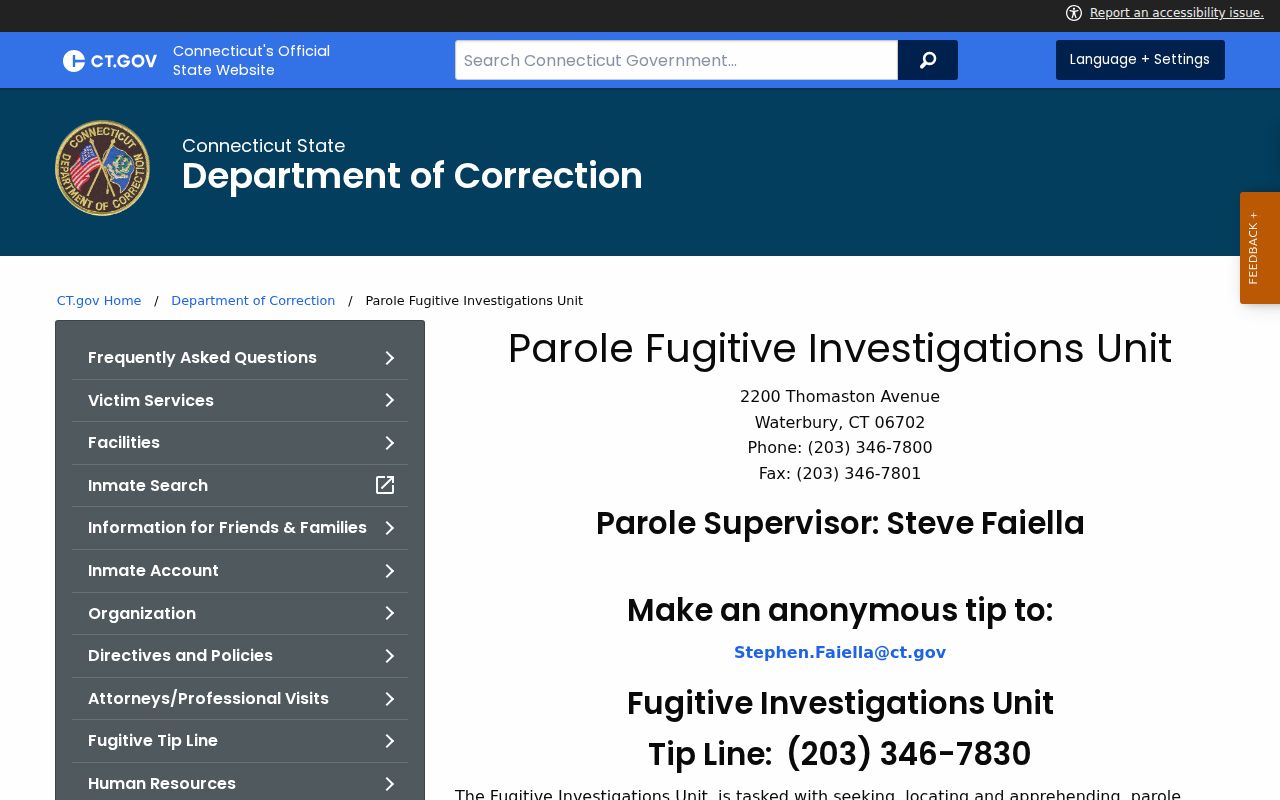
That program page keeps the focus on scope. It also explains why a parole-fugitive tip channel should never be used for an unrelated Fairfield County bench warrant or arrest warrant question.
How to Report a Tip Safely
Send a tip only to the agency named in the official alert. The Connecticut State Police "Your Help Is Needed" page is a statewide tip route, not a personal warrant lookup. Use 911 for an emergency. For a non-emergency sighting in Fairfield County, avoid confrontation and pass along plain facts.
- Open the live agency page and confirm the notice is official.
- Use the phone or online channel stated on that notice.
- Report the place, time, and conduct observed without pursuit.
- Keep any reference number and let trained officers respond.
Safety first: Do not approach, follow, detain, or publicize a person from an official alert. Report facts and step away.
The official capture below shows a public tip program without copying a named alert.
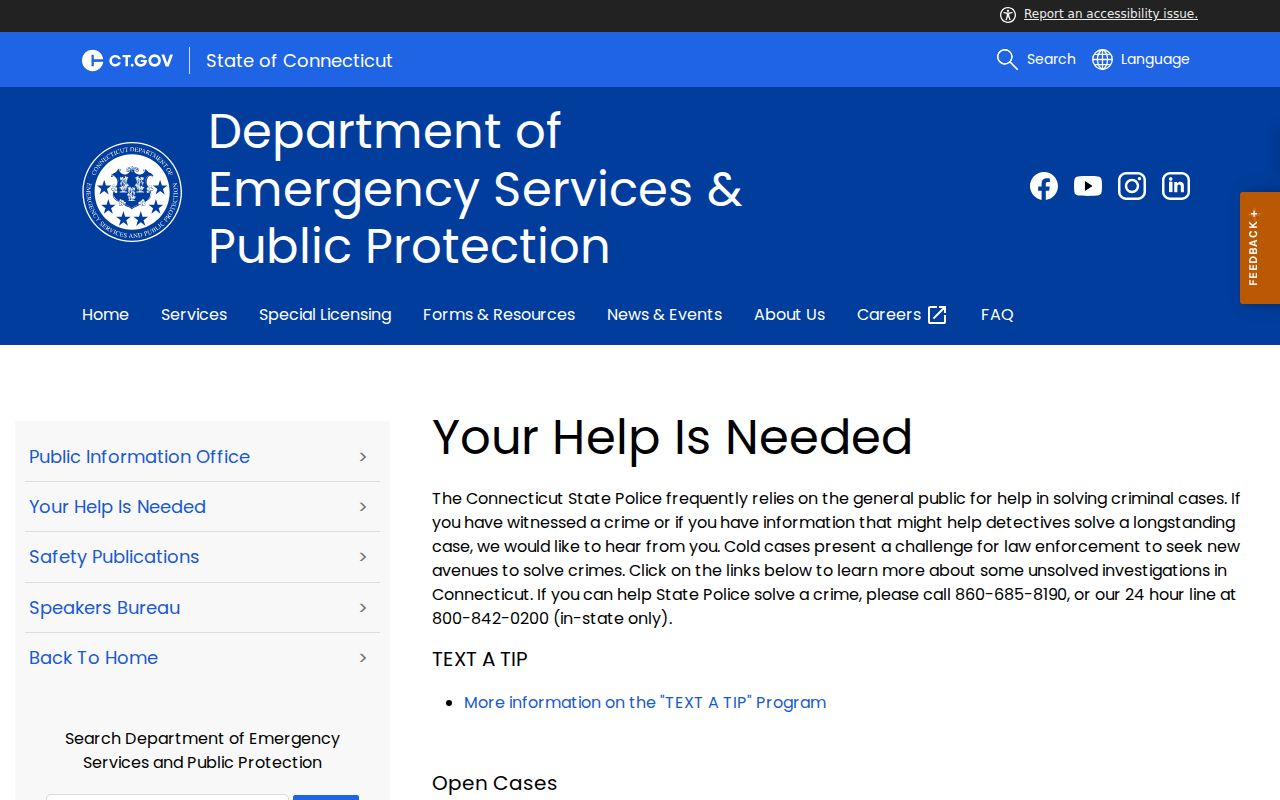
That page exists for reporting. Your own warrant question belongs with counsel, the court portal, and the right Fairfield County Superior Court clerk.
Fairfield County Fugitive Program Limits
The U.S. Marshals District of Connecticut page names the Connecticut Violent Crimes Fugitive Task Force and lists district contacts. It also says no fugitive information is available for that district. The task force still investigates and apprehends fugitives. Nothing on it is a Fairfield County warrant list. Federal process is separate from Connecticut Superior Court process. PACER provides federal docket access when a public case exists, but it is not a nationwide warrant self-check. Sealed process may not appear. A personal federal concern goes to federal counsel or the federal clerk for a known case. A state VOP search cannot clear a federal warrant, and a Marshals page cannot clear a state warrant in Fairfield County.
Most Wanted vs an Active Warrant
Selection is the key difference. A most-wanted notice is an agency's message about a limited priority, while an active warrant is legal process whether or not any Fairfield County program highlights it.
| Feature | Most-wanted alert | Active warrant |
|---|---|---|
| Purpose | Seek tips for a selected matter | Authorize arrest or another court-directed act |
| Scope | Small program subset | Any process still executable |
| Public route | Live agency alert | Limited portal, clerk, agency file |
| Status authority | Publishing agency for its alert | Issuing Superior Court |
| Safe response | Report and do not approach | For yourself, call counsel and clerk |
Not every alert points to an active Connecticut warrant. Parole, escapee, state, and federal programs in Fairfield County each carry different authority and different records.
PRAWN and Fairfield County Warrants
PRAWN holds arrest-warrant details for approved criminal-justice users across Fairfield County and the state. The public cannot log in. Sealed files, juvenile privacy, safety concerns, and open investigations all shape what it releases, and COLLECT and CJIS wanted-data access stay restricted too.
- Fugitive program
- An agency effort focused on a defined group, such as parole absconders.
- Court docket
- The case-side record maintained by the Superior Court clerk.
- Active warrant
- Process still treated as executable, subject to court confirmation.
- Recalled or quashed
- Court action withdrawing or ending the process.
One incident can leave traces in several record systems. Fairfield County courts control a warrant's judicial status, while police may keep their own booking or service material.
No Fairfield County Reward Program
Fairfield County has no standing reward program for ordinary warrant tips. Connecticut's gubernatorial reward statute exists, but it is not a routine county system. Fairfield County also runs no countywide amnesty or warrant-recall event. The 2006 Operation Park City swept Greater Bridgeport with coordinated warrant service. It was enforcement. Amnesty it was not. Treat reward offers in Fairfield County with suspicion. A caller may promise to clear a warrant in exchange for payment, gift cards, cryptocurrency, or account details. Hang up. Use only a number the Judicial Branch or the responsible agency publishes. A warrant moves only through court action, an appearance, service, or another authorized step. No tip payment changes that. A real tip line wants useful observations and keeps the public away from confrontation. It sells nothing, promises no recall, and charges no fee. Check the agency domain and current phone number before sending anything. If the question is your own case, skip the tip line and call the right criminal clerk or counsel.
If You Believe You Are on a List
Skip the tip line for your own name. If VOP or FTA may be involved, start with the limited court search. Fairfield County dockets sit in the Fairfield, Danbury, Stamford, or Norwalk GA/JD court. Ask that court's criminal clerk about procedure for your docket. A lawyer can plan a motion, an appearance, or a voluntary surrender.
Important: Do not arrive at an agency without case-specific instructions. Counsel can confirm the warrant and help arrange a lawful response.
Keep the clerk's instructions, docket confirmation, bond receipt, release paper, and any later court order. Arrest or bond does not end the case. Attend the next date and get written confirmation of any recall. The Fairfield County warrant records overview shows how court and police records fit together.
Fairfield County has no central booking desk or county jail window. If surrender is advised in Fairfield County, ask counsel or the responsible agency where intake occurs and what identification is needed. A bail commissioner may set or recommend conditions before a judge reviews them. The court can require a written promise, nonfinancial conditions, cash, or a surety bond. Do not infer these steps from a public alert. Get instructions tied to the actual docket. Program pages can lag a legal change. Only the responsible court or agency can say what an update means. Do not circulate saved names or images. Keep the inquiry on your own status, a relative you are helping, or facts that belong in an official safety tip.