
How to Check for a Warrant in Danbury
Use the Judicial Branch VOP/FTA search first. It is only a limited Danbury check. A September 8, 2026 notice suspended ordinary FTA display until further notice, though direct searches could still locate some related cases.
- Search your own last name or docket.
- Record any Danbury court reference.
- Confirm process with GA 3 or Danbury JD criminal clerk.
- Use Danbury Police only for its arrest, incident, or service file.
- Ask counsel about the safest response and retain written proof.
A blank Danbury result rules out nothing. Sealed, federal, bench, arrest, youthful-offender, and newly entered process can all stay out of view. Searching takes at least the first two letters of a last name, with town and court location as filters, plus first name, birth year, or a year range to narrow a personal match. PRAWN is not a public search box. That statewide network serves authorized justice agencies, not Danbury warrant lookups. Treat Judicial Branch case information as context only. Its display is not the official court record for a Danbury docket.
Danbury Warrants at 146 White
Danbury Judicial District and GA 3 both sit at 146 White Street. Verify access details before a visit. The Judicial Branch directory lists Clerk Public Information at 203-207-8600. The Court Service Center number is 203-207-8766. The clerk holds the court side of Danbury warrant records. Ask the clerk about procedure for a specific docket. The service center supplies forms and navigation, not legal advice. The Danbury JD route takes cases from Danbury, Bethel, Brookfield, New Fairfield, Newtown, Redding, Ridgefield, and Sherman, so identify the originating case rather than trusting residence alone.
The Danbury Police Department and Municipal Court
Danbury Police splits its record contacts by type: traffic, accident, incident, and more. The Records and Property Division handles agency-copy questions. Judicial status stays with the court clerk. Danbury runs no municipal criminal court. Local criminal and motor-vehicle cases go to Connecticut Superior Court at GA 3 or the assigned Judicial District, not to any city warrant counter.
Danbury Police Records
Agency arrest, incident, and service files
Use the official division page
Danbury JD and GA 3
146 White Street, Danbury
203-207-8600
The official capture below identifies the police records route.
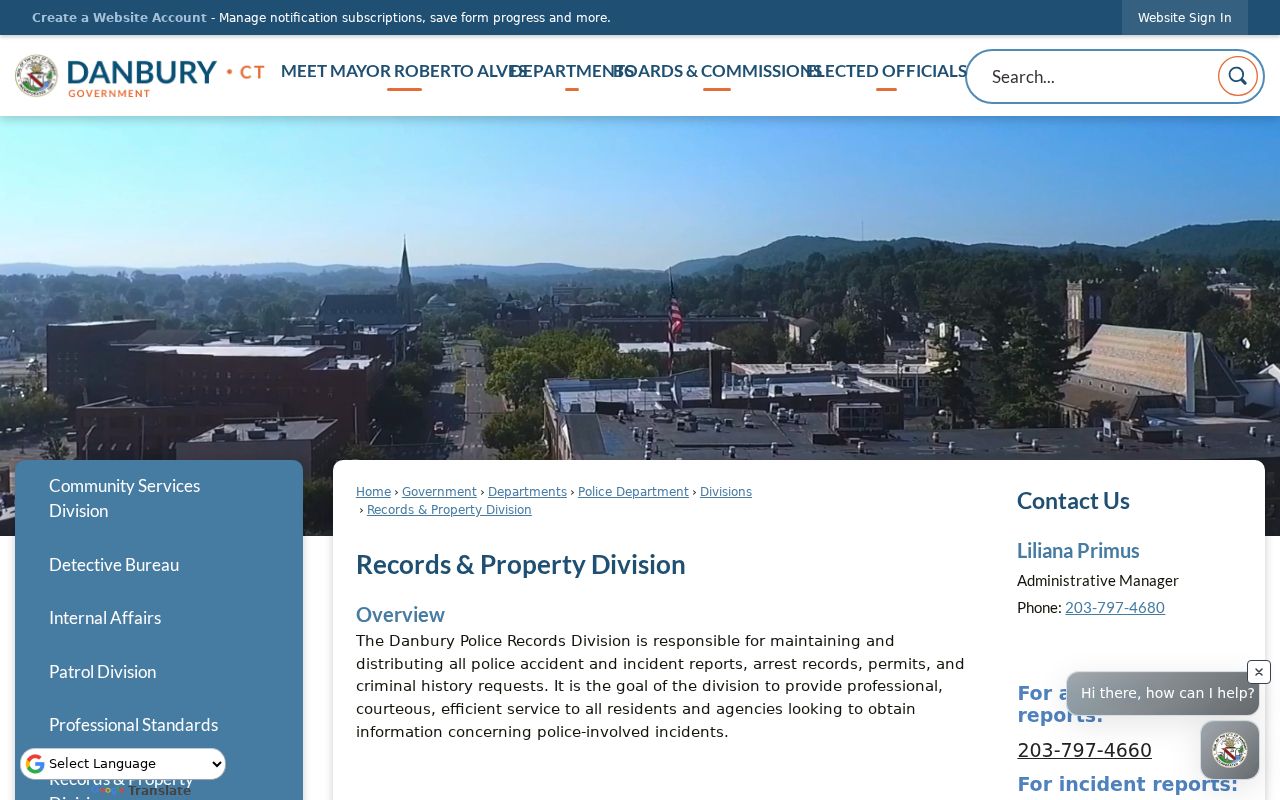
An agency file cannot recall a warrant or replace a court order.
Danbury Warrant FOI Requests
Danbury's official police FOIA form asks what material you want. Email it to pd-records@danbury-ct.gov or drop it off. A strong request gives a narrow date range, identifies your own event, and names the record type. Do not ask the police to do legal research. The “Material Requested” field should describe the event in enough detail to locate it, with added detail on a separate page. The form opens a channel. It is not a searchable Danbury warrant database. A receipt proves Danbury received the request, nothing more. It does not prove GA 3 process was recalled, served, or cleared. Keep the Danbury FOI result and any later court order as separate papers. If part of a Danbury agency file is exempt, ask for the statutory basis and any public portion that can be split out. An FOI access dispute gives the Freedom of Information Commission no power to recall a criminal warrant.
Types of Danbury Warrants
Danbury warrant paper comes from Superior Court, since the city has no municipal criminal court. A bench warrant is judge-issued arrest paper. An FTA rearrest warrant follows an alleged missed appearance, while a capias can compel a witness or defendant to appear. Labels differ; the right response differs too.
| Type | How it starts | Confirm with |
|---|---|---|
| Arrest warrant | Probable-cause application | Court and police custodian |
| Bench warrant | Judge-issued arrest papers | GA 3 or assigned clerk |
| FTA rearrest warrant | Missed required date | Clerk and limited portal |
| VOP warrant | Claimed probation violation | Clerk and limited portal |
| Capias | Statutory order to compel appearance | Issuing court |
None of these Danbury warrant types dies of old age; only court action can recall or quash one.
Danbury Traffic and Warrant Routes
For city traffic matters, the Danbury Police Traffic Division lists 203-797-4500. Still-payable Connecticut infractions run through the state CIBE portal. Once the answer date passes or FTA court process looms, take the question to CIBE first and then the right court clerk. The official Traffic Division page shows Danbury's traffic contact, not a warrant search.
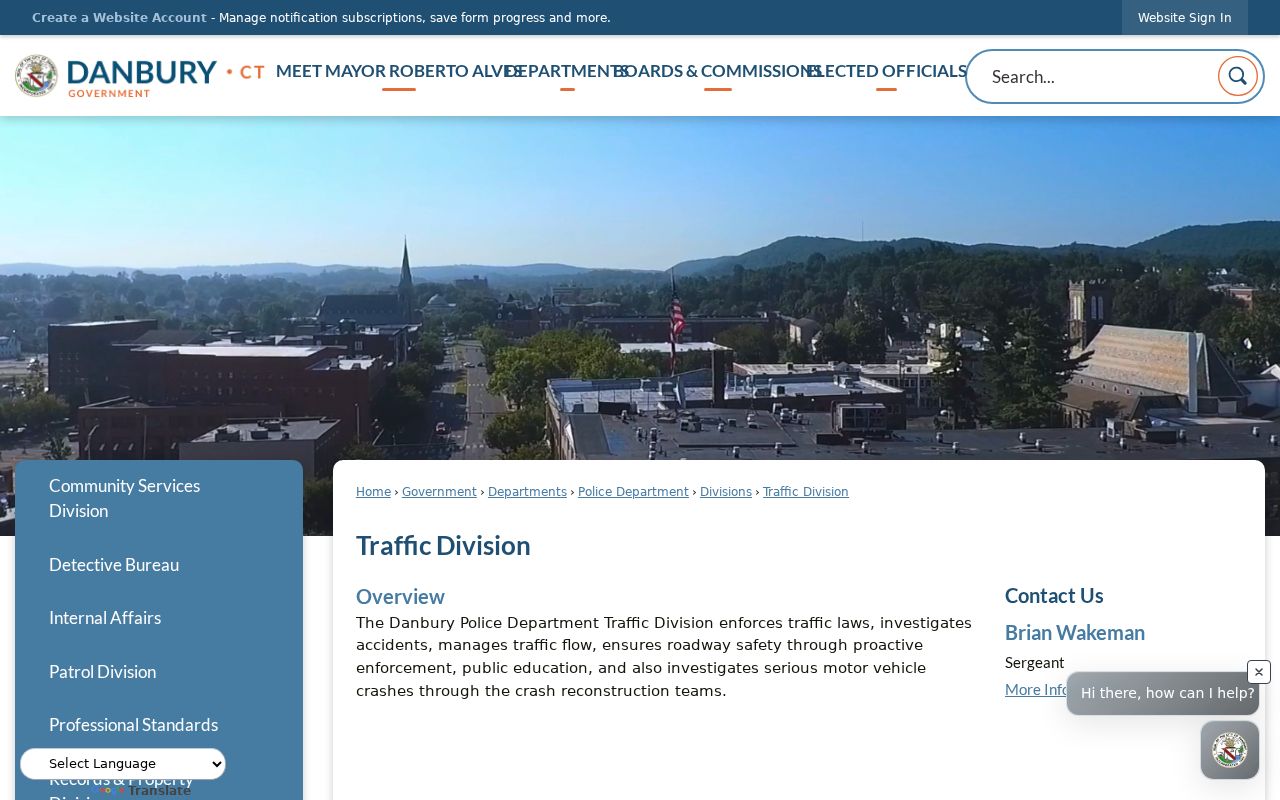
City traffic administration, state ticket processing, and GA 3 judicial process remain distinct.
What a Danbury Warrant Record Shows
What a record shows depends on its source. Access limits matter too. A court docket, a police file, and a restricted PRAWN entry may describe one Danbury event with different fields and update times, so identify the record holder before reading a status word as final.
| Docket | A court identifier, represented here only as GA3-CR. |
|---|---|
| Court | GA 3, Danbury JD, or another assigned Superior Court. |
| Process | Arrest, bench, FTA, VOP, capias, or another label. |
| Issue date | Entry timing, not current-status proof. |
| Status | Active, served, recalled, quashed, or not publicly shown. |
| Bond | A release condition only when displayed. |
Match identifiers and ask the clerk for current confirmation.
Missed Danbury Warrant Court Date
Miss a required date in Danbury? Call the Danbury criminal clerk. Ask whether the docket shows a bench warrant or an FTA rearrest warrant, and what procedure is available. State law generally blocks an FTA rearrest warrant or capias before 4:00 p.m. on the day of the claimed failure, absent good cause. That rule says nothing about one docket's current status. A clerk may describe a motion, an appearance, or a surrender process, but cannot pick a strategy for you.
- Gather the notice and docket.
- Request procedural information from the clerk.
- Ask counsel how to act.
- Confirm any booking instructions before travel.
- Attend the new court date and save the order.
Bond or release never ends the underlying Danbury case. A bail commissioner may set or recommend conditions after police custody, but the court controls what happens next. Keep the release paper, bond receipt, order, and new hearing date. Never assume a Danbury warrant expired on its own.
Danbury Warrant Activity Is Historical
Old counting tools get mistaken for live Danbury lists. A 2021 OPM municipal tabulation lists historical PRAWN activity categories such as warrants issued, warrants served, and foreign warrants served. Those month-specific numbers are not a current Danbury active-warrant list. They should not be used to rank municipalities either. The same caution applies statewide. The 2024 to 2025 FTA/VOP quarterly reports are statewide snapshots, not Danbury totals. Danbury posts no public warrant roster. For personal status, the Danbury docket and clerk answer, not a table. The report labels themselves differ. "Issued" counts process entered during a reporting period, while "served" counts agency action. Neither label lists warrants open on the day you check. The 2021 municipal table also tracks foreign-warrant service, which can involve process from outside the city. Treat those figures as dated system context only. They cannot tell you whether a specific GA 3 docket is current, recalled, or closed.
Danbury Warrant Resolution Proof
Each paper proves a different step in Danbury. An FOI receipt proves a request. A police file documents an agency event, a bond receipt records release terms, and a court order or updated docket shows recall, quashing, or disposition.
- Served
- Police action occurred; the case can remain open.
- Recalled
- The court withdrew process.
- Quashed
- The court ended its force.
- Bond
- A financial or nonfinancial condition meant to secure appearance.
An online copy alone is not proof that a warrant was cleared. Keep every paper, and note where it came from. When the Danbury clerk says process was recalled, ask which docket entry or order documents that action in court. If police later serve the warrant or update an agency file, keep that record too. The two papers answer different questions. A request receipt proves access activity, while a court order states the judicial result.
Where Danbury Warrants Fit With Fairfield County
Warrant flow: Danbury Police application or service › GA 3 or Danbury JD process › PRAWN for authorized agencies.
PRAWN is not public. The VOP/FTA page shows only a limited layer. Police keep agency files, while the court controls process status. The Fairfield County warrant records overview maps other county court routes when the issuing location is uncertain. For a Danbury case, keep GA 3 and local records at the center of the inquiry.
Public Access to Danbury Warrant Records
The Connecticut FOI guidance explains inspection, written requests, and lawful fees. Records are presumed open unless an exemption applies. Juvenile, erased, sealed, investigative, victim, witness, and safety material can be restricted. So describe exactly what you want. Danbury's police form works best when "Material Requested" names a specific event, date range, and record type. Danbury accident, incident, and traffic records each follow a distinct route. Use the published email or drop-off channel and retain the submitted form. An agency can ask for clarification when a description runs too broad. Inspection may be enough. Choose it when a certified or paper copy is not needed. Lawful fees and prepayment rules can still apply to copies or media. Police custody ends where court custody begins. Danbury Police can answer about its own arrest, service, or incident material. GA 3 and the Danbury JD clerks maintain the judicial entries. A request sent to pd-records@danbury-ct.gov cannot act as a motion to recall. A clerk call will not produce every police report either. That split explains why someone may hold a Danbury police record and still need a court update.
If material is withheld, ask for the statutory basis and for any non-exempt portion that can be separated. The Freedom of Information Commission hears Danbury access disputes. It cannot erase lawful confidentiality. Nor can it direct the criminal court to change a Danbury warrant. Firm limits protect juveniles, erased cases, witnesses, victims, active investigations, and safety concerns. A missing Danbury record implies nothing. Build a dated trail after any Danbury warrant inquiry. Save the portal result, docket, clerk contact, FOI receipt, agency response, release paper, bond receipt, and court order as separate records. A served warrant can leave the case pending. A Danbury bond secures appearance but does not dispose of the charge. Only the court's later action establishes recall, quashing, or final disposition. Attend the next date and check the docket again. Beware anyone demanding remote payment to stop immediate arrest. Danbury runs no amnesty day and posts no public warrant roster, so call the published court or city number yourself. Gift cards and cryptocurrency are not safe warrant-resolution instructions. Counsel can verify the process and help arrange a lawful appearance.
Access rule: Request a focused Danbury police file, but ask the Superior Court clerk for the warrant's present judicial status.
Even a successful Danbury access appeal cannot force release of lawfully sealed material or recall a warrant.